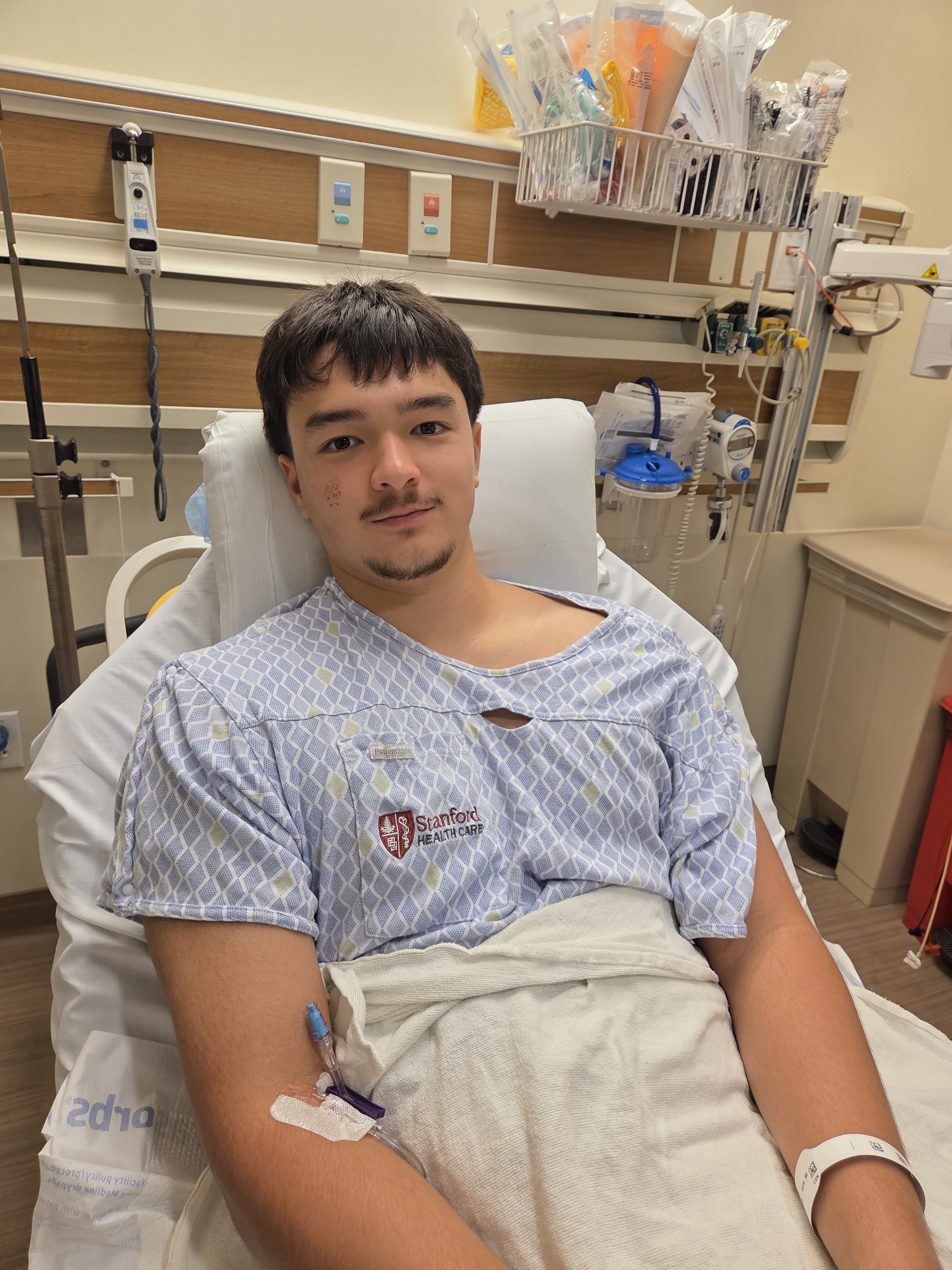

Our son, Aidan, was a typical teenager. He was enjoying trade school, going to the gym, and spending time with his mates when he began complaining of intermittent headaches. At first, we assumed they were caused by dehydration, a passing virus, or simply a lack of sleep. But as the headaches became more frequent and severe, we booked an appointment with our GP, who referred him for an MRI.
I will never forget the MRI technician coming out to tell us that Aidan had a large brain tumour. It was the absolute last thing I expected to hear.
The radiology clinic sent us straight to the Sunshine Coast University Hospital Emergency Department, where Aidan was admitted and prepared as though he was heading directly into surgery. However, no one could tell us anything beyond the fact that there was a tumour beneath his brain. We were referred to the Royal Children's Hospital in Brisbane and told to travel there the following morning.
At the Royal Children's Hospital, Aidan underwent another MRI and a CT scan. The staff were compassionate, but they could offer very little additional information. We were sent home while his case was discussed at the multidisciplinary team meeting. Tuesday came and went without any news. After countless phone calls and another week of waiting, we finally secured an appointment at Princess Alexandra Hospital. Knowing something was seriously wrong but having no diagnosis or treatment plan was agonising.
While we waited, we reached out to friends and family for guidance. Through those connections, we learned that Aidan's tumour was likely a chordoma. Although that possibility was terrifying, it finally gave us something to research. We found the Chordoma Foundation, whose website provided comprehensive information about the disease, standard treatment recommendations, and practical questions to ask our doctors.
When we met with the team at Princess Alexandra Hospital, they confirmed that Aidan most likely had a clival chordoma. Although the surgeons were highly skilled in skull base surgery, it became clear they had limited experience treating chordoma specifically. When we asked the questions recommended by the Chordoma Foundation, we didn't feel we were receiving answers that aligned with established chordoma treatment guidelines.
It was incredibly stressful to feel that we couldn't completely trust the advice we were receiving, while also not knowing where else to turn. Through the Chordoma Foundation, we connected with other Australian chordoma patients and families who shared their experiences. They helped us understand the importance of achieving a complete resection during the first surgery and introduced us to specialists with extensive experience treating chordoma.
Australia has many outstanding medical professionals. However, because chordoma is so rare, few surgeons have the opportunity to build significant experience treating it. Our greatest challenge was finding medical advice that reflected international best practice. We quickly realised that if we wanted to give Aidan the best possible chance of a long-term cure, we needed to research the disease ourselves and advocate for his care.
The Chordoma Foundation became a lifeline. It not only provided trustworthy medical information but also connected us with a community of patients and families who understood exactly what we were going through. We genuinely believe the Foundation and the patients who shared their experiences helped make Aidan's treatment outcome possible.
Because Aidan's tumour was wrapped around delicate nerves and critical arteries, we knew the best chance of a successful long-term outcome was to seek care from a highly experienced chordoma team. We ultimately made the decision to travel to Stanford Hospital in the United States.
Seeking treatment overseas was emotionally overwhelming and financially daunting, but it has been worth every sacrifice. Only weeks after surgery, Aidan has achieved a complete resection while preserving his eyesight and avoiding damage to other critical parts of his brain. We are incredibly grateful to Dr. Juan Fernandez-Miranda and his entire team.
Travelling overseas for treatment came with many challenges. Australian private health insurance does not cover overseas medical care, even when local options are insufficient. In addition to the cost of treatment itself, we had to cover travel, accommodation, living expenses, and an extended period away from work during treatment and recovery.
Being overseas also meant being separated from our family and friends. For Aidan, being away from his mates and missing so much school was especially difficult. We were incredibly fortunate to have family and friends who rallied around us, helping to fund Aidan's treatment and supporting us in countless practical ways, from watering our plants to simply being a caring voice on the other end of the phone.
Another source of stress was knowing that travel insurance would not cover medical repatriation or complications related to travelling for medical treatment. The medical bills for an overseas patient are eye-watering, but when it is your child, it is impossible to put a price on giving them the best possible chance.
Research has already transformed the outlook for people diagnosed with chordoma. Treatment and patient outcomes today are far better than they were just a decade ago, thanks almost entirely to medical research. Continued investment in research will lead directly to better care, improved treatments, and better survival.
Australia cannot conduct large-scale chordoma research alone because so few people are diagnosed each year. It is essential that Australia continues to participate in international research collaborations and welcomes leading chordoma specialists to work alongside and train Australian clinicians.
We also believe families facing rare diseases should be assigned dedicated patient advocates from the very beginning. Navigating a rare cancer is incredibly complex, and an advocate could help families access evidence-based care while guiding them through an overwhelming healthcare system. Investing in the right treatment from the outset also has the potential to reduce recurrences and lower healthcare costs in the long term.
Finally, Australia needs dedicated Centres of Excellence for rare diseases such as chordoma. Rather than patients fighting isolated battles across different hospitals, centralising care would allow specialists to build genuine expertise, improve collaboration, and deliver world-class treatment.
Aidan is only at the beginning of his chordoma journey, but we hope that by sharing our experience we can help improve outcomes for every Australian family diagnosed with this rare disease.