
Our journey began after what seemed like an ordinary workplace accident in June 2009. Rob was pinned beneath a tractor, and while doctors were investigating his injuries, they discovered a lesion on his T10 vertebra. What followed was a biopsy, multiple imaging tests, and a diagnosis that ultimately proved to be wrong.
Initially, we were told that he had clear cell carcinoma, a rare form of kidney cancer that had spread to his spine. Rob underwent major spinal surgery at the Wesley Hospital in Brisbane, followed by six weeks of gamma radiation treatment, believing we were fighting metastatic cancer.
When the tumour returned in 2012, further testing eventually revealed that the original diagnosis was incorrect. Rob had a thoracic chordoma, a rare, one-in-a-million bone cancer. We had never heard of it before, and neither had many of the medical professionals we encountered.
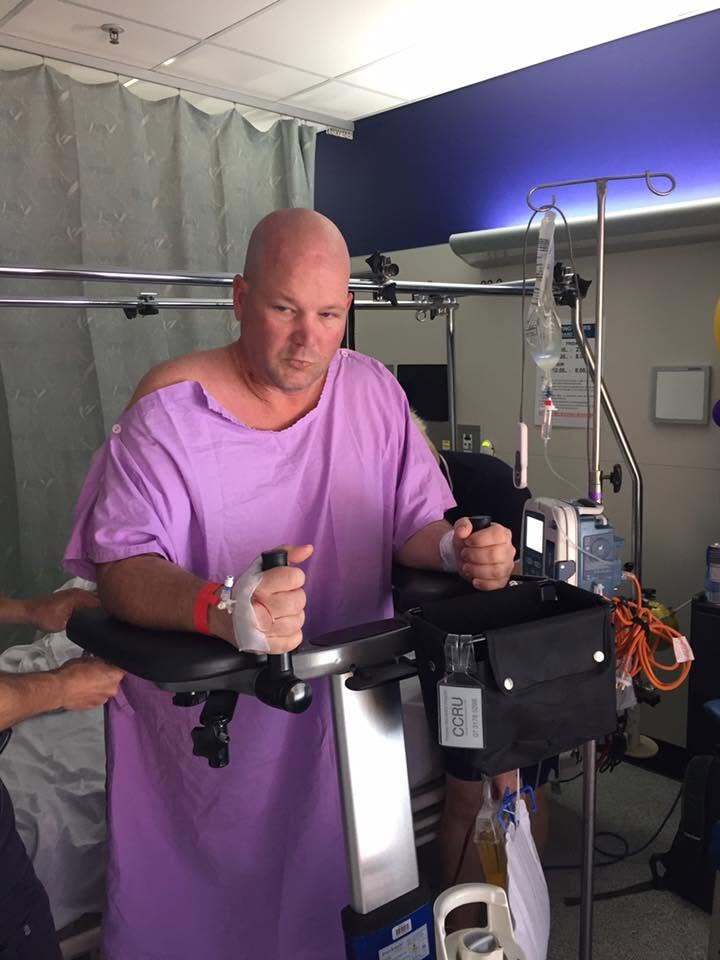
Since that day, chordoma has been a constant part of our lives. Rob has experienced several recurrences of the disease and has endured almost 20 surgeries over the past 18 years, including multiple complex spinal reconstructions. Every recurrence has brought another round of difficult decisions, long hospital stays, rehabilitation, and the emotional weight of wondering what comes next.
Because chordoma is so rare and Rob’s tumour involves the spine, his case has consistently been considered highly complex. Over the years, Queensland Health has determined that his condition is beyond the scope of what can be treated locally, meaning we have had to seek specialist care interstate.
Today, Rob is under the care of an extraordinary multidisciplinary team at St Vincent’s Private Hospital in Sydney. While we are incredibly grateful for their expertise, receiving treatment hundreds of kilometres from home comes with enormous emotional, financial, and logistical challenges. Every appointment, scan, and surgery requires extensive travel, time away from family, accommodation costs, and weeks, sometimes months, of recovery away from our support network.
Access to advanced treatments has also been a significant hurdle. Rob has been denied funding for proton beam therapy on two separate occasions, despite evidence supporting its role in the treatment of chordoma. Those decisions were incredibly difficult to accept, particularly when proton therapy is recognised internationally as an important treatment option for many people with this disease. Knowing that a potentially beneficial treatment exists but remains out of reach has been one of the most frustrating aspects of our journey.
Financially, the impact has been significant. Accessing the specialised care Rob needs has required repeated travel from Queensland to Sydney for consultations, scans, surgeries, and follow-up appointments. Those trips involve flights, accommodation, meals, time away from work, and countless incidental expenses that quickly accumulate. Like many families living with a rare disease, we have often found ourselves focused less on building financial security and more on simply accessing the treatment that gives Rob the best chance.
The ongoing nature of chordoma has also affected our ability to plan for the future. Career opportunities, family holidays, and life milestones have often been postponed or reshaped around treatment schedules and recovery. Cancer has a way of becoming part of every decision you make.
When you are diagnosed with a common cancer, there are often well-established treatment pathways and decades of research to guide decisions. With chordoma, that is simply not the reality. Every treatment decision can feel like stepping into the unknown because the evidence base is limited, clinical trials are few, and many healthcare professionals will never encounter a patient with chordoma during their careers.
Over the past 18 years, we have experienced firsthand how research has the power to change lives. Advances in surgical techniques have allowed Rob to undergo operations that were once considered impossible. Researchers continue to deepen our understanding of chordoma biology, opening the door to more targeted treatments and giving families like ours genuine reason to believe the future can be different.
We have also learnt that research does not happen by chance. It requires investment, collaboration, and a long-term commitment from governments, researchers, clinicians, and the wider community. Every discovery has the potential to improve survival, reduce disability, and spare another family from the uncertainty we have lived with.
If I could say one thing to decision-makers, it would be this: rare cancers are still cancers. Just because fewer people are diagnosed does not make them any less devastating. People living with rare cancers deserve the same opportunity to access expert care, innovative treatments, and life-saving research as anyone else.
I would also ask decision-makers to recognise that patients with rare diseases often face barriers long before treatment begins. Access to specialists, interstate travel, funding for emerging therapies, and equitable healthcare pathways should not depend on where you live or how rare your diagnosis is.